1. Utangulizi
This user manual provides detailed instructions for the Waveshare Raspberry Pi 4 Model B Display Kit. It covers the assembly, setup, operation, and maintenance of your 7-inch capacitive touch LCD display kit designed for the Raspberry Pi 4. Please read this manual thoroughly before use to ensure proper functionality and to maximize your experience with the product.
2. Yaliyomo kwenye Kifurushi
Verify that all items listed below are included in your package. If any components are missing or damaged, please contact customer support.

Image: All components included in the Waveshare Raspberry Pi 4 Display Kit.
- 7-inch Capacitive Touch LCD
- Acrylic Case (Black/White)
- Kebo ya HDMI
- USB-A to Micro-USB Cable (for touch and power)
- Adapta ya Nguvu
- Kadi Ndogo ya SD (GB 16)
- Kisomaji cha Kadi ndogo ya SD
- Screws and Standoffs for assembly
3. Bidhaa Imeishaview
The Waveshare Raspberry Pi 4 Model B Display Kit combines a high-resolution 7-inch capacitive touch screen with essential accessories, allowing you to build a compact, all-in-one computer solution with your Raspberry Pi 4.
3.1 Raspberry Pi 4 Model B Features (Raspberry Pi board sold separately)
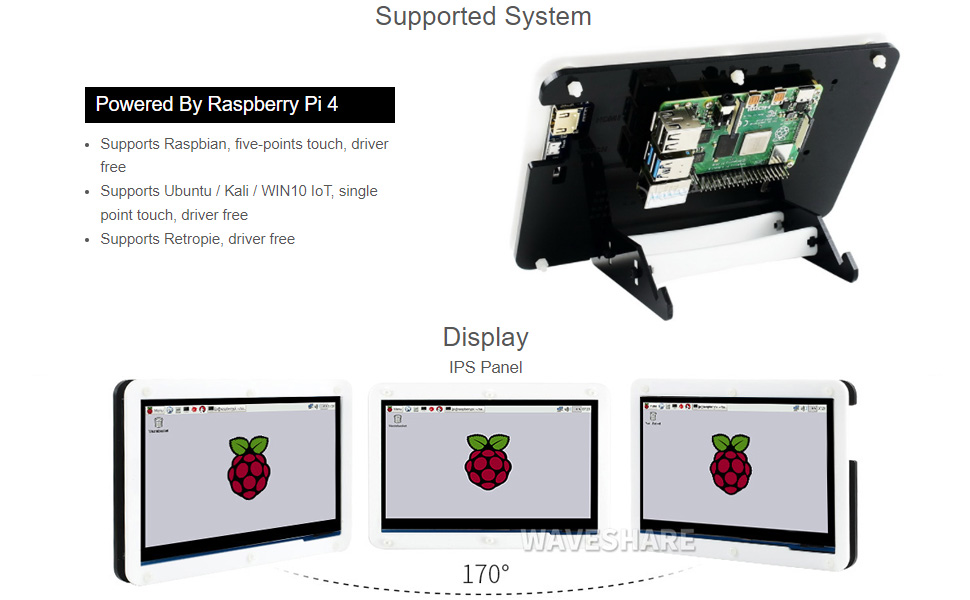
Image: Raspberry Pi 4 Model B board layout with key components labeled.
- Kichakataji: Broadcom BCM2711, Quad core Cortex-A72 (ARM v8) 64-bit SoC @ 1.5GHz
- Kumbukumbu: LPDDR4-2400 SDRAM (available in 1GB, 2GB, 4GB, or 8GB options)
- Muunganisho: 2.4 GHz and 5.0 GHz IEEE 802.11ac wireless, Bluetooth 5.0, Gigabit Ethernet
- Bandari za USB: Milango 2 ya USB 3.0, milango 2 ya USB 2.0
- Video na Sauti: 2 × micro-HDMI ports (up to 4Kp60 supported), 2-lane MIPI DSI display port, 2-lane MIPI CSI camera port, 4-pole stereo audio and composite video port
- GPIO: Kichwa cha GPIO cha pini 40
- Nguvu: 5V DC via USB-C connector (minimum 3A recommended)
4. Mwongozo wa Kuweka
Follow these steps to assemble and set up your Waveshare Raspberry Pi 4 Display Kit.
4.1 Hardware Assembly

Image: Fully assembled Waveshare Raspberry Pi 4 Display Kit.
- Prepare the Raspberry Pi: Ensure your Raspberry Pi 4 Model B board is ready.
- Mount the Raspberry Pi: Attach the Raspberry Pi 4 board to the designated mounting points on the back panel of the acrylic case using the provided screws and standoffs.
- Connect the Display: Connect the 7-inch LCD to the Raspberry Pi 4. Typically, this involves connecting the HDMI cable from the display to one of the micro-HDMI ports on the Raspberry Pi, and the USB-A to Micro-USB cable for touch functionality and power.
- Assemble the Case: Secure the front panel of the acrylic case around the display and then attach it to the back panel, enclosing the Raspberry Pi and display. Ensure all cables are properly routed and not pinched.
- Ambatisha Stendi: Assemble and attach the included stand to the bottom of the case for stable positioning. The stand often allows for adjustable viewing angles (e.g., 45° or 60°).
4.2 Usanidi wa Programu
The Waveshare 7-inch capacitive touch LCD is designed for driver-free operation with several popular operating systems.
- Ufungaji wa Mfumo wa Uendeshaji: Install your preferred operating system (e.g., Raspbian, Ubuntu, Kali, WIN10 IoT, Retropie) onto the provided 16GB Micro SD card using a suitable imaging tool (e.g., Raspberry Pi Imager).
- Weka Kadi ya SD: Insert the prepared Micro SD card into the Raspberry Pi's Micro SD card slot.
- Washa: Connect the power adapter to the display kit. The Raspberry Pi and display should power on automatically.
- Uendeshaji Bila Dereva: For most supported systems, the display and touch functionality will work automatically without additional driver installation.
5. Maagizo ya Uendeshaji
5.1 Utendaji Kazi wa Kugusa

Image: User interacting with the capacitive touch screen.
- The 7-inch display features a capacitive touch panel, supporting up to five-point touch input.
- Ensure the USB touch cable is securely connected between the display and the Raspberry Pi for touch input to function.
- Touch gestures and multi-touch capabilities will depend on the operating system and applications running on your Raspberry Pi.
5.2 Mifumo ya Uendeshaji Inayotumika
The display kit offers broad compatibility with various Raspberry Pi operating systems:
- Raspbian: Supports five-point touch, driver-free.
- Ubuntu / Kali / WIN10 IoT: Supports single-point touch, driver-free.
- Retropie: Supports driver-free operation.
6. Vipimo
| Kipengele | Vipimo |
|---|---|
| Ukubwa wa Kuonyesha | inchi 7 |
| Aina ya Kugusa | Capacitive, up to 5-points |
| Kiolesura | HDMI for display, USB for touch |
| Utangamano | Raspberry Pi 4 Model B |
| Usaidizi wa Mfumo wa Uendeshaji | Raspbian, Ubuntu, Kali, WIN10 IoT, Retropie |
| Memory Storage Capacity (SD Card) | GB 16 |
| Uzito wa Kipengee | Pauni 1.28 |
| Nambari ya Mfano | PI4B Display Acce |
| Mtengenezaji | Waveshare |
7. Matengenezo
- Kusafisha: Tumia kitambaa laini kisicho na pamba ili kufuta skrini kwa upole. Kwa smudges mkaidi, kidogo dampjw.org sw kitambaa chenye maji au kisafishaji kisicho salama kwenye skrini. Epuka kemikali kali au vifaa vya abrasive.
- Hifadhi: When not in use, store the kit in a cool, dry place away from direct sunlight and extreme temperatures.
- Kushughulikia: Handle the display and Raspberry Pi board with care to avoid physical damage. Avoid applying excessive pressure to the screen.
8. Utatuzi wa shida
8.1 Hakuna Toleo la Onyesho
- Angalia Nguvu: Ensure the power adapter is securely connected to the display kit and plugged into a working power outlet.
- Muunganisho wa HDMI: Verify that the HDMI cable is firmly connected between the display and the Raspberry Pi's micro-HDMI port. Try a different micro-HDMI port if available.
- Kadi ya SD: Confirm that the Micro SD card with a properly installed operating system is inserted correctly into the Raspberry Pi.
- Ugavi wa Nguvu: Ensure your Raspberry Pi is receiving adequate power (a 5V/3A USB-C power supply is recommended for Raspberry Pi 4).
8.2 Utendaji Kazi wa Kugusa Haufanyi Kazi
- Muunganisho wa USB: Check that the USB-A to Micro-USB cable is securely connected from the display to a USB port on the Raspberry Pi.
- Usaidizi wa Mfumo wa Uendeshaji: Confirm that your operating system supports the touch functionality of this display. While most are driver-free, some configurations might require specific settings.
- Washa upya: Try rebooting the Raspberry Pi.
8.3 Screen Flickering or Instability
- Ugavi wa Nguvu: Ensure a stable and sufficient power supply is used for both the display and the Raspberry Pi.
- Uadilifu wa Kebo: Check the HDMI and USB cables for any damage or loose connections.
9. Udhamini na Msaada
For warranty information, technical support, or further assistance, please refer to the official Waveshare webtovuti au wasiliana na mchuuzi wako. Weka risiti yako ya ununuzi kama dhibitisho la ununuzi kwa madai ya udhamini.


