1. Bidhaa Imeishaview
The DIYmall 0.96 Inch Blue OLED Module is a compact, self-illuminating display featuring 128x64 pixels. It utilizes an I2C/IIC serial interface, requiring only two I/O pins for communication. This module is designed for integration with various microcontroller platforms, including Arduino, Micro:bit, 51 series, MSP430 series, and STIM32/2/SCR chips. Its blue display offers a wide viewing angle of over 160 degrees and operates with low power consumption.
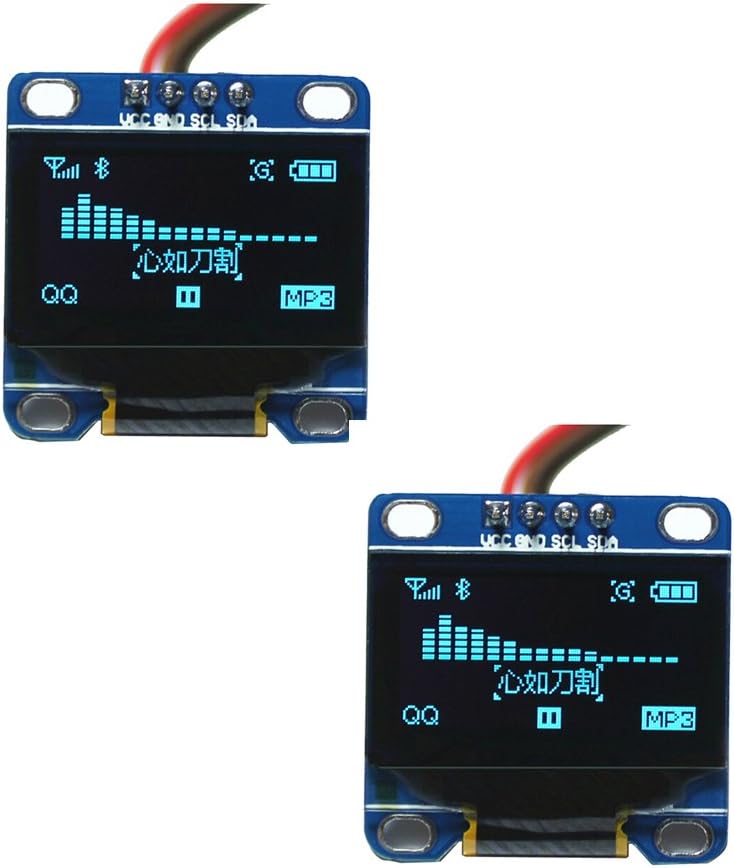
2. Vipimo
| Kipengele | Maelezo |
|---|---|
| Ukubwa | Inchi 0.96 |
| Rangi | Bluu |
| Azimio | pikseli 128x64 |
| ViewAngle | Greater than 160 degrees |
| Majukwaa Yanayotumika | Arduino, 51 series, MSP430 series, STIM32/2, SCR chips, Micro:bit |
| Matumizi ya Nguvu | 0.04W (normal operation) |
| Voltage Msaada | 3.3V-5V DC |
| Joto la Kufanya kazi | -30 hadi 80 digrii Celsius |
| Dimensions (Volume) | 27mm x 27mm x 4.1mm |
| Dereva IC | SSD1306 |
| Kiolesura cha Mawasiliano | IIC (I2C), 2 I/O ports required |
| Font Handling | Software-based word modulo (no built-in font) |
| Mwangaza nyuma | OLED self-illuminating, no separate backlight required |
| Vipimo vya Bidhaa (L x W x H) | Inchi 1.18 x 1.97 x 1.18 |
| Uzito wa Kipengee | 0.353 wakia |
| Nambari ya Mfano | FZ1112 |


3. Kuweka
This section outlines the basic steps for connecting and preparing your DIYmall 0.96 Inch Blue OLED Module for use with a microcontroller.
3.1 Wiring Connections (Arduino Example)
The OLED module communicates via I2C (also known as IIC), requiring four connections:
- VCC: Ugavi wa umeme (3.3V-5V)
- GND: Ardhi
- SCL: Serial Clock Line (I2C Clock)
- SDA: Serial Data Line (I2C Data)
For an Arduino UNO, typical connections are:
- OLED VCC to Arduino 5V (red wire)
- OLED GND to Arduino GND (black wire)
- OLED SCL to Arduino A5 (white wire)
- OLED SDA to Arduino A4 (yellow wire)

3.2 I2C Address Configuration
The I2C address of the module can be changed if necessary. Refer to the product's third picture for details on modifying the IIC address by adjusting a resistor.

3.3 Library Installation (Arduino IDE)
To use the OLED module with Arduino, you will need to install the appropriate libraries. The Adafruit SSD1306 library is commonly used. Ensure you also have the Adafruit GFX library installed as it is a dependency.
Hatua:
- Fungua IDE ya Arduino.
- Nenda kwa Mchoro > Jumuisha Maktaba > Dhibiti Maktaba...
- Tafuta "SSD1306" and install the "Adafruit SSD1306" library.
- Tafuta "GFX" and install the "Adafruit GFX Library".
- For clock functionality with ESP32, you may also need the "RTClib" library.
For detailed instructions on library installation and code examples, refer to the following video:
4. Kufanya kazi
Once the module is wired and libraries are installed, you can upload example code to test its functionality and begin your projects.
4.1 Basic Display Functionality
The Adafruit SSD1306 library includes examples that demonstrate various display functions such as drawing shapes, text, and bitmaps. These examples are a good starting point to verify your setup.

4.2 Using with ESP32 and Clock Module
The OLED module can be combined with an ESP32 development board and a DS3231 Real-Time Clock (RTC) module to create projects requiring time display. Ensure correct wiring between the ESP32, RTC, and OLED module.
Connection Diagram (ESP32, DS3231, OLED):
- ESP-32 3V3/5V kwa DS3231 VCC na OLED VCC
- ESP-32 GND kwa DS3231 GND na OLED GND
- ESP-32 D21 kwa DS3231 SDA na OLED SDA
- ESP-32 D22 kwa DS3231 SCL na OLED SCL
Refer to the following video for a visual guide on connecting and using the OLED module with an ESP32 and clock module:
5. Matengenezo
The DIYmall 0.96 Inch Blue OLED Module is a robust component, but proper handling and care will ensure its longevity and optimal performance.
- Kushughulikia: Avoid applying excessive pressure to the display surface. Handle the module by its edges to prevent damage to the screen or circuit board.
- Kusafisha: If necessary, gently clean the display surface with a soft, dry, lint-free cloth. Do not use abrasive cleaners or solvents.
- Hifadhi: Store the module in a dry, anti-static environment, away from direct sunlight and extreme temperatures.
- Ugavi wa Nguvu: Always ensure your power supply voltage is within the specified 3.3V-5V DC range to prevent damage.
6. Utatuzi wa shida
If you encounter issues with your OLED module, consider the following troubleshooting steps:
- Onyesho Lisilowaka:
- Verify all wiring connections (VCC, GND, SDA, SCL) are correct and secure.
- Hakikisha ugavi wa umeme ujazotage iko ndani ya masafa ya 3.3V-5V.
- Check if the microcontroller is powered on and running the code.
- Incorrect Display Output or No Output:
- Anwani ya I2C: The default I2C address for the SSD1306 is often 0x3C or 0x3D. If your code uses 0x3D and the display is not working, try changing it to 0x3C in your code (e.g.,
display.begin(SSD1306_SWITCHCAPVCC, 0x3C);). Refer to Image 3.2 for physical address modification if needed. - Library Issues: Confirm that the Adafruit SSD1306 and Adafruit GFX libraries are correctly installed and updated in your Arduino IDE.
- Code Errors: Review your code for any syntax errors or logical issues. Use the Arduino IDE's serial monitor to check for debug messages.
- Bandika Majukumu: Double-check that the SDA and SCL pins in your code match the physical pins you've connected on your microcontroller.
- Anwani ya I2C: The default I2C address for the SSD1306 is often 0x3C or 0x3D. If your code uses 0x3D and the display is not working, try changing it to 0x3C in your code (e.g.,
- Onyesho linalopeperuka:
- Hakikisha ugavi wa umeme thabiti.
- Angalia miunganisho iliyolegea.
For further assistance, consult online forums and resources related to SSD1306 OLED displays and your specific microcontroller platform.
7. Udhamini na Msaada
For warranty information or technical support regarding your DIYmall 0.96 Inch Blue OLED Module, please contact DIYmall directly through their official channels or the retailer from whom the product was purchased. Keep your proof of purchase for any warranty claims.

