
SatLink WS 6909
SatLink WS-6909 DVB-S/DVB-T Combo Satellite Signal Finder Meter User Manual
1. Utangulizi
The SatLink WS-6909 is a versatile digital meter designed for aligning both DVB-S (satellite) and DVB-T (terrestrial) signals. Featuring a 3.5-inch high-definition TFT LCD screen, it allows users to view actual channels directly on the device, ensuring quick and accurate signal alignment. The meter includes a unique calibration system for optimal performance and supports various satellite and terrestrial signal parameters.
Kumbuka: DVB-T functionality may not be supported in all regions, including America.
2. Yaliyomo kwenye Kifurushi
Tafadhali thibitisha kuwa bidhaa zote zilizoorodheshwa hapa chini zimejumuishwa kwenye kifurushi chako:
- 1 x SatLink WS-6909 Satellite Meter
- Adapta ya Nguvu 1 x
- 1 x AV Cable
- 1 x Cable ya Chaja ya gari
- 1 x Silicone Case
3. Bidhaa Imeishaview
Familiarize yourself with the components and ports of your SatLink WS-6909 meter.

Kielelezo cha 3.1: Mbele view of the SatLink WS-6909 meter, showing the 3.5-inch LCD screen, control buttons, and numeric keypad, alongside its protective orange silicone case.

Kielelezo cha 3.2: Chini view of the device, featuring the main power switch, DC power input port, and a USB port for software upgrades.

Kielelezo cha 3.3: Upande view of the meter, illustrating the AV IN and AV OUT ports for connecting external video sources or displays.
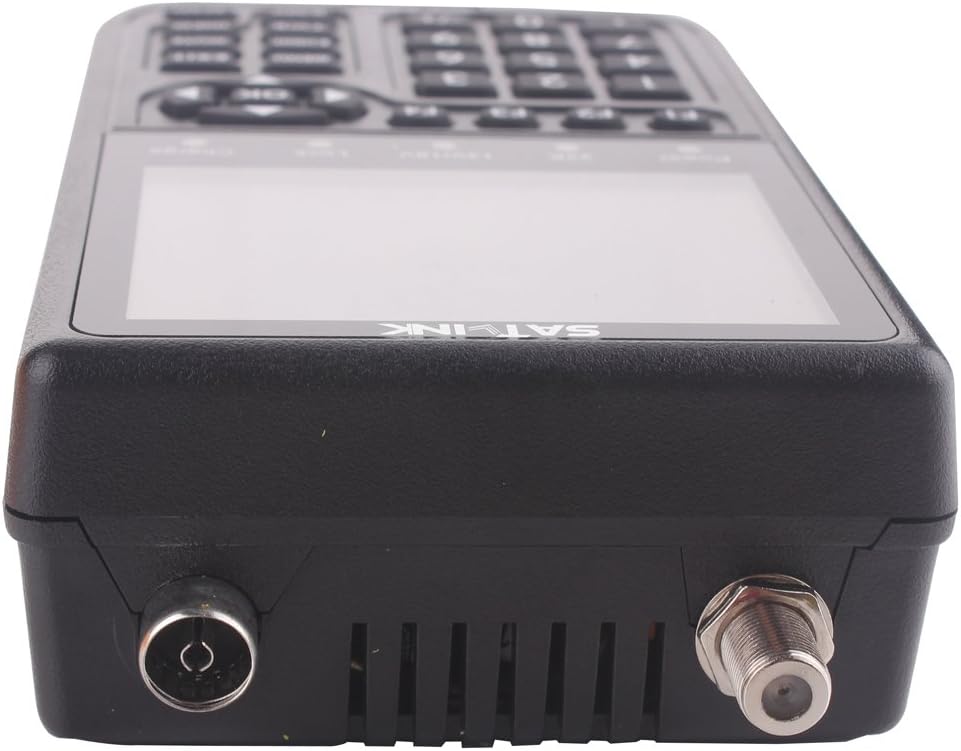
Kielelezo cha 3.4: Juu view of the device, displaying the F-connector for satellite input and the standard antenna input for terrestrial signals.
4. Kuweka
4.1 Kuchaji Kifaa
- Connect the provided Power Adaptor to the DC input port on the bottom of the meter.
- Plug the Power Adaptor into a standard electrical outlet. The 'Charge' indicator light on the device will illuminate.
- Allow the device to charge fully before initial use. A full charge provides approximately 4 hours of operating time.
- Alternatively, use the Car Charger Cable to charge the device in a vehicle.
4.2 Umeme wa Awali Umewashwa
- Ensure the device is adequately charged.
- Flip the main power switch located on the bottom of the meter to the 'ON' position.
- The device will power on and perform an automatic calibration for optimal performance.
4.3 Connecting Antennas/LNBs
- For satellite signal reception (DVB-S), connect the LNB cable from your satellite dish to the F-connector input on the top of the meter.
- For terrestrial signal reception (DVB-T), connect your terrestrial antenna cable to the standard antenna input on the top of the meter.
5. Maagizo ya Uendeshaji
5.1 Urambazaji Msingi
- Tumia MENU kifungo cha kufikia menyu kuu.
- Navigate through menu options using the directional arrow buttons (JUU / CHINI / KUSHOTO / KULIA).
- Bonyeza kwa OK button to confirm selections or enter sub-menus.
- Tumia EXIT kitufe cha kurudi kwenye skrini iliyotangulia au kutoka kwenye menyu.
- The numeric keypad can be used for direct input of values such as frequencies or channel numbers.
5.2 DVB-S (Satellite) Signal Finding
- From the main menu, select the DVB-S measurement mode.
- Configure parameters such as satellite, transponder frequency, symbol rate, and polarity. These settings can be modified by the user.
- The meter supports DISEQC 1.0, 1.1, 1.2, and 22kHz Tone. Adjust these settings as required for your LNB configuration.
- The meter provides LNB power supply options of 18V/13V (maximum 400mA).
- Align your satellite dish while observing the signal strength, quality, BER (Bit Error Rate), S/N (Signal-to-Noise ratio), and PWR (Power) on the 3.5-inch LCD screen.
- The device will provide a sound and light alarm when a signal is locked.
- The meter can automatically calculate Azimuth (AZ) and Elevation (EL) angles to assist with dish alignment.
- Search modes include Auto, Blind, and Manual.
5.3 DVB-T (Terrestrial) Signal Finding
- From the main menu, select the DVB-T measurement mode.
- Configure the desired frequency range.
- The meter supports ANT power supply options of 5V/12V/24V for active antennas.
- Align your terrestrial antenna while observing the signal strength, quality, MER (Modulation Error Ratio), S/N (Signal-to-Noise ratio), and PWR (Power) on the LCD screen.
- The meter supports multichannel checks and demodulation types including QPSK, 16QAM, and 64QAM.
- Search modes include Auto and Manual.
5.4 Software Upgrades
The USB port on the bottom of the device is used for software upgrades. Refer to the manufacturer's website for the latest software and instructions.
6. Matengenezo
6.1 Kusafisha
- Futa kifaa nje na kitambaa laini, kavu.
- Usitumie visafishaji vya kioevu au viyeyusho, kwani vinaweza kuharibu kifaa.
6.2 Utunzaji wa Betri
- Ili kuongeza muda wa matumizi ya betri, epuka kuweka kifaa kwenye halijoto kali.
- Recharge the battery regularly, even if the device is not in frequent use.
6.3 Usasisho wa Programu
Mara kwa mara angalia rasmi ya mtengenezaji website for available software updates. Updating the firmware can improve performance and add new features.
7. Utatuzi wa shida
| Tatizo | Sababu inayowezekana | Suluhisho |
|---|---|---|
| Kifaa hakiwashi | Low battery; Power switch off; Faulty power adapter | Charge the battery; Ensure power switch is ON; Try a different power source |
| No signal detected (DVB-S) | Incorrect satellite/transponder settings; LNB not powered; Dish misalignment; Cable issue | Verify satellite and transponder settings; Check LNB power (13/18V); Adjust dish alignment; Inspect cable connections |
| No signal detected (DVB-T) | Incorrect frequency; Antenna not powered (if active); Antenna misalignment; Regional DVB-T incompatibility | Verify frequency settings; Check ANT power (5/12/24V); Adjust antenna alignment; Confirm DVB-T support in your region |
| Ubora duni wa ishara | Fine-tuning needed; Obstructions; Damaged LNB/antenna | Make small adjustments to alignment; Clear line of sight; Replace faulty components if necessary |
| Skrini imeganda au haifanyi kazi | Hitilafu ya programu | Perform a hard reset by turning the power switch OFF and then ON again. If persistent, consider a software upgrade. |
8. Vipimo
- Onyesha: 3.5 Inchi ya Juu Ufafanuzi TFT LCD Screen
- Betri: 8.4V/3000mAh Li-ion, Max Operating Time: 4 hours
- DVB-S Input Frequency: 950-2150MHz
- DVB-S Input Level: -65 hadi -25dBm
- DVB-S Input Impedance: 75Ω
- DISEQC Support: 1.0, 1.1, 1.2 and 22kHz Tone
- LNB Power Supply: 18V/13V (IMax 400mA)
- DVB-T Frequency Range: 46MHz-862MHz
- DVB-T Level Range: 40dBµV-110dBµV
- DVB-T Input Impedance: 75Ω
- DVB-T Demodulation: QPSK, 16QAM, 64QAM
- ANT Power Supply: 5V/12V/24V
- Aina za Upimaji: Signal strength, quality, BER, S/N, PWR (DVB-S); Signal strength, quality, MER, S/N, PWR (DVB-T)
- Njia za Utafutaji: Auto, Blind, Manual
- Vipimo vya Bidhaa: Inchi 3.54 x 1.77 x 6.46
- Uzito wa Kipengee: Pauni 1.76
- Nambari ya Mfano: WS6909
9. Udhamini na Msaada
For technical assistance, warranty information, or customer support, please contact your original retailer or refer to the manufacturer's official website for contact details. Please have your product model number (WS 6909) and purchase information ready when seeking support.
Ask a question about this manual
Ask about setup, troubleshooting, compatibility, parts, safety, or missing instructions. Manuals+ will review the question and use this page’s manual context to help answer it.